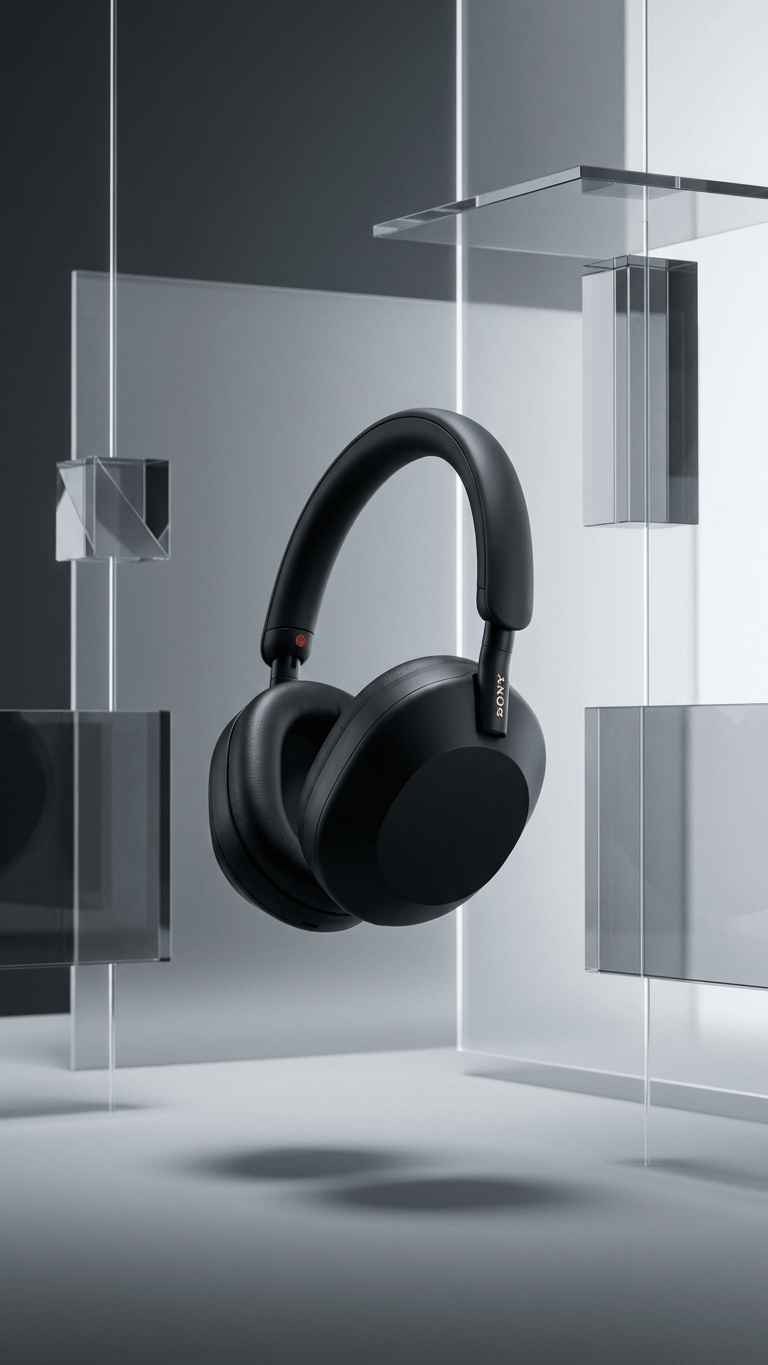
Bose QuietComfort Ultra vs Sony WH-1000XM5: Which Headphones Should You Buy in 2026?
Two of the most popular premium noise-cancelling headphones of their generation. Both are excellent — but neither is the current flagship anymore. In 2026, the real question isn't which is technically better. It's how much you're paying for each one.
Important Transparency Note: YallaBuy did not personally purchase or laboratory-test the Bose QuietComfort Ultra or Sony WH-1000XM5. We therefore do not claim that we personally measured their battery life, ANC performance, microphone quality, or sound response.
Instead, this comparison combines manufacturer specifications, independent laboratory measurements, hands-on testing from established audio publications, expert listening impressions, documented long-term ownership reports, and current-generation product information.
We also separate different types of evidence. Manufacturer specifications are useful for official battery ratings, supported codecs, features, compatibility, and hardware. Independent testing is treated separately from manufacturer claims — for example, Bose rates the first-generation QC Ultra for up to 24 hours of battery life, while SoundGuys measured 27 hours and 37 minutes in its standardized continuous playback test. That does not mean Bose officially promises 27+ hours; the two figures were produced under different conditions. Expert opinions are partly subjective, which is why this guide does not treat one reviewer's opinion as absolute truth. Owner reports can help identify recurring reliability concerns, but isolated complaints should not automatically be treated as proof of a widespread defect.
Quick Answer
Choose the Bose QuietComfort Ultra 1st Gen if you prioritize comfort, travel, and slightly stronger overall noise isolation. Choose the Sony WH-1000XM5 if you prioritize battery life, call quality, Sony's feature ecosystem, and LDAC. Consider neither if the price is close to the newer Bose QC Ultra 2nd Gen or Sony WH-1000XM6.
The biggest factor in 2026 is no longer simply which headphone is technically better. It is: How much are you paying for each one?
✓ Buy Bose QC Ultra if
Comfort is your top priority
You travel frequently and want a foldable design
You want slightly stronger noise isolation
You prefer a richer, more energetic sound
It's heavily discounted vs the 2nd Gen
● Buy Sony XM5 if
Battery life matters most (30h vs 24h rated)
You take a lot of calls
You want LDAC on a compatible Android device
You like Sony's feature-rich app ecosystem
It's substantially cheaper than the XM6
Check Current Amazon Price
Price Disclaimer: Product prices can change frequently, especially on Amazon and during major sales events. The price shown when you read this article may be different from the current retailer price. Always check the current price before purchasing.
The Bose QuietComfort Ultra (1st Gen) and Sony WH-1000XM5 were two of the most popular premium noise-cancelling headphones of their generation. Both offer excellent active noise cancellation, comfortable over-ear designs, strong sound quality, transparency modes, Bluetooth multipoint, and useful smartphone apps.
But there is an important difference in 2026: neither model is the current flagship anymore. Bose has released the QuietComfort Ultra 2nd Gen, while Sony has moved on to the WH-1000XM6. That changes the buying decision considerably.
The first-generation Bose QC Ultra can still make sense when heavily discounted because it remains excellent at noise cancellation, comfort, portability, and everyday travel. The Sony WH-1000XM5 can also be a strong value option when its price drops significantly.
So which one should you actually buy?
Quick Comparison
Feature
Bose QC Ultra 1st Gen
Sony WH-1000XM5
Type
Over-ear ANC
Over-ear ANC
Launch generation
2023
2022
Battery with ANC
Up to 24 hours
Up to 30 hours
Battery without ANC
—
Up to 40 hours
Weight
~250–254g
~250g
Bluetooth
Bluetooth 5.x
Bluetooth 5.2
Main codecs
SBC, AAC, aptX Adaptive
SBC, AAC, LDAC
Multipoint
Yes
Yes
Wired connection
3.5mm
3.5mm
USB-C audio
No
No
Spatial audio
Bose Immersive Audio
Sony spatial features
EQ
Yes
Yes
Foldable
Yes
No traditional folding hinges
Water resistance
No official IP rating
No official IP rating
Current successor
QC Ultra 2nd Gen
WH-1000XM6
Best for
Comfort, ANC, travel
Battery, calls, versatility
Sony officially rates the XM5 for up to 30 hours with noise cancelling enabled and 40 hours with ANC off, and supports SBC, AAC and LDAC. Bose rates the first-generation QC Ultra for up to 24 hours with Immersive Audio turned off. SonyBose
Bose QuietComfort Ultra 1st Gen: What Are You Getting?
The Bose QuietComfort Ultra was introduced as Bose's flagship over-ear noise-cancelling headphone in late 2023. Its biggest selling points were never simply the number of features. Bose focused heavily on:
Active noise cancellation
Comfort
Customizable listening modes
Bose Immersive Audio
CustomTune
Travel portability
Premium wireless audio features
The headphones also support Bluetooth multipoint, allowing two source devices to remain connected at the same time. Bose added multipoint support through a software update in 2024.
The QC Ultra uses a folding design, which gives it an advantage for people who travel frequently. That advantage becomes even more important when compared with headphones that take up more space inside a bag.
Sony WH-1000XM5: What Are You Getting?
The Sony WH-1000XM5 was Sony's premium flagship noise-cancelling headphone before the arrival of the XM6. Sony built the XM5 around:
Strong ANC
30-hour battery life with ANC
LDAC
Multipoint
Adaptive sound features
Speak-to-Chat
Quick Attention
Wearing detection
DSEE Extreme
Strong microphone performance
Sony officially states that the XM5 uses four microphones on each earcup for noise cancelling and includes automatic noise-cancelling optimization based on wearing conditions and the environment. Sony
The XM5 also supports LDAC, Sony's higher-bitrate Bluetooth codec, and can connect to two Bluetooth devices simultaneously.
Price: The Most Important Part in 2026
Originally, these headphones were positioned as expensive flagship products. The Bose QC Ultra launched at approximately $429 in the US, while the Sony WH-1000XM5 launched around $399. What Hi-Fi? notes that the Bose originally sat above the XM5 in price. What Hi-Fi?
But those launch prices are no longer the most important numbers. Both headphones are now previous-generation products. That means their value depends heavily on discounts.
Our rule for 2026
Don't buy the QC Ultra 1st Gen simply because it was once a $400+ flagship. And don't buy the XM5 simply because it was once Sony's flagship. Instead, compare their current prices against the newer models.
If the QC Ultra 1st Gen is heavily discounted — It can be an excellent value.
If the price is close to the QC Ultra 2nd Gen — The newer model makes more sense because it adds meaningful upgrades including USB-C digital audio and longer battery life. Bose says the 2nd Gen can reach up to 30 hours and supports USB-C audio. Bose
If the XM5 is heavily discounted — It becomes much more attractive. Recent market pricing can make the XM5 significantly cheaper than the XM6, which changes the value equation. What Hi-Fi? has continued to describe the XM5 as a compelling option when discounted even after the arrival of the XM6. What Hi-Fi?
Always check the current Amazon price before buying. Prices can change frequently.
Design and Build Quality
Bose QC Ultra
The Bose QC Ultra uses a lightweight over-ear design with a folding mechanism. Its major advantage is portability.
What Hi-Fi? praised the folding design and found the QC Ultra comfortable for long listening sessions, while noting that the construction does not feel quite as luxurious as some more expensive metal-heavy competitors. SoundGuys measured the headphones at around 253g and highlighted the lightweight construction as an advantage for daily use. What Hi-Fi?SoundGuys
The design combines plastic exterior components with metal reinforcement in important areas. That means calling it simply a "plastic headphone" would be misleading. At the same time, it does not have the same all-metal feel as some premium competitors.
Bose design advantages
Lightweight
Foldable
Compact travel case
Comfortable padding
Good seal
Easy physical controls
Bose disadvantages
No official IP water-resistance rating
Some premium competitors feel more luxurious
First-generation model lacks USB-C audio
Sony XM5 Design
The XM5 weighs approximately 250g according to Sony's specifications. It is lightweight and comfortable, but its design is different from the Bose.
One important difference is portability. The Bose QC Ultra folds in a more traditional compact way, while the XM5's newer hinge design does not provide the same type of folding arrangement. Sony focuses more on a minimalist appearance. The XM5 also uses touch controls instead of relying primarily on physical buttons.
Comfort
Winner: Bose QC Ultra
Comfort is one of the strongest reasons to buy the Bose. The QC Ultra has relatively low weight, generous ear cushions, and a well-balanced clamping force. What Hi-Fi? rated its comfort highly and found it suitable for long listening sessions. SoundGuys also emphasized the lightweight 253g design and soft padding. What Hi-Fi?SoundGuys
The Sony XM5 is also very comfortable. But if comfort is your number-one priority, the Bose gets the slight advantage.
Best for long flights? Bose.
Best for long work sessions? Bose or Sony.
This category is close enough that head shape, glasses, ear size, and personal preference can change the result.
Active Noise Cancellation
Winner: Bose QC Ultra — but the difference is not huge
This is probably the strongest reason to choose the Bose. Bose has a long history with ANC, and the QC Ultra continues that reputation.
What Hi-Fi? found the Bose slightly better than the XM5 in noise cancellation during its direct comparison, particularly with low-frequency environmental noise. SoundGuys also found the QC Ultra highly effective at reducing environmental noise and reported approximately 87% reduction for certain real-world noises such as bus engines, train noise, and airplane noise under its testing methodology. What Hi-Fi?SoundGuys
However, these numbers should not be interpreted as a universal guarantee. ANC performance depends on:
Ear shape
Ear-pad seal
Glasses
Head movement
Environment
Frequency of the noise
Test methodology
So we would not say: "Bose destroys Sony in ANC." That is too strong. A more accurate conclusion is:
The Bose QC Ultra has a slight overall ANC advantage, while the Sony XM5 remains one of the strongest ANC headphones in its class.
Bose is especially attractive for
Airplane engines
Trains
Buses
Low-frequency background noise
Travel
Sony remains excellent for
Office environments
Everyday city noise
Voices
General commuting
ANC winner: Bose QC Ultra
Transparency / Aware Mode
Both headphones have transparency modes. Bose calls its main transparency experience Aware Mode. SoundGuys found the Bose Aware mode quite natural and useful in environments such as streets and cafes. Bose also provides ActiveSense, which can automatically adjust the experience when environmental sounds become louder. SoundGuys
Sony's Ambient Sound mode is also very good. The difference here is relatively small.
Winner: Bose, by a small margin
Sound Quality
This is where the comparison becomes much more complicated. There is no single objective answer to: "Which sounds better?" Different independent reviewers have reached somewhat different conclusions. And that's exactly why you should be careful with absolute statements.
Bose Sound
What Hi-Fi? praised the Bose for its rich presentation, full-bodied sound, punchy bass, dynamic delivery, and detailed presentation. At the same time, What Hi-Fi? described the Sony as leaner and more transparent.
RecordingNOW went even further, finding the QC Ultra significantly improved after EQ and describing its sound as highly detailed and enjoyable after adjustment. That is a useful observation, but it is still an expert listening opinion rather than a universal measurement. What Hi-Fi?RecordingNOW
What Does SoundGuys Say?
SoundGuys takes a more measurement-oriented approach. Its testing found the QC Ultra generally good for an ANC headphone but also identified issues involving distortion and channel matching. It also found that the Immersive Audio effect did not necessarily improve the listening experience. SoundGuys
This doesn't necessarily contradict subjective reviews. A headphone can have imperfect measurements and still sound extremely enjoyable. Likewise, a headphone can measure very well while a listener personally dislikes its tuning.
EQ Changes the Bose Experience
The QC Ultra includes a three-band EQ in the Bose app. This allows you to adjust bass, midrange, and treble. This matters because some listeners find the stock Bose tuning too bass-heavy. Reducing the bass and adjusting the midrange and treble can produce a more balanced presentation. So the Bose QC Ultra should not be judged solely on its factory tuning.
Sony Sound
The Sony XM5 has a different character. What Hi-Fi? praised its clarity, detail, precise bass and natural presentation. In the direct comparison, What Hi-Fi? preferred the Sony for overall sound quality while describing the Bose as richer and fuller.
Sony also includes DSEE Extreme, which is designed to process compressed audio. And the XM5 supports LDAC, which can provide higher-bitrate Bluetooth audio with compatible devices. Sony says LDAC can transmit roughly three times the data of conventional Bluetooth audio. What Hi-Fi?Sony
Sound Quality Verdict
Choose Bose if
You like richer sound
You prefer stronger bass
You enjoy EQ customization
You want a more energetic presentation
Choose Sony if
You prefer a more natural presentation
You want strong clarity
You use LDAC
You prefer Sony's processing features
Overall: Tie — personal preference wins. This is one category where it would be misleading to declare one headphone universally superior.
Bose CustomTune vs Sony Sound Processing
Bose uses CustomTune technology to personalize the headphone's audio and noise-control experience based on the user's ear characteristics. That means two people can potentially perceive the same headphone somewhat differently.
Sony takes a different approach through technologies such as DSEE Extreme and its sound-processing ecosystem. This is another reason why a specification sheet alone cannot tell you which headphone will sound better to you.
Immersive Audio vs Sony Spatial Features
Bose introduced Immersive Audio with the QC Ultra. It provides two main modes:
Still — The virtual sound stays positioned in front of you even as you move your head.
Motion — The virtual presentation changes with your head movement.
The concept is interesting. But whether it actually improves music is another question.
What Hi-Fi? found Bose Immersive Audio somewhat unconvincing and noted that it reduces battery life. SoundGuys similarly found that Immersive Audio changed the experience more than it improved it and noted some audio-quality compromises. What Hi-Fi?SoundGuys
Our verdict
Don't buy the Bose specifically for Immersive Audio. Think of it as an additional feature. You may love it. You may never use it.
Battery Life
Winner: Sony WH-1000XM5
This is one of the easiest categories to decide.
Sony officially rates the XM5 at:
30 hours with ANC ON
40 hours with ANC OFF
Bose rates the original QC Ultra at:
24 hours with Immersive Audio OFF
18 hours with Immersive Audio ON
Interestingly, SoundGuys measured the Bose at 27 hours and 37 minutes in its standardized test. That demonstrates why manufacturer ratings and independent measurements should be kept separate. The official Bose rating is still the correct figure to use when describing what Bose promises. SonyBoseSoundGuys
Battery winner: Sony WH-1000XM5 — If you travel frequently or simply hate charging your headphones, Sony is the safer choice.
Charging
Both headphones use USB-C for charging. The Bose QC Ultra supports quick charging, with Bose stating that a 15-minute charge can provide around 2.5 hours of playback under the relevant conditions. Sony's XM5 can also provide several hours of playback from a short charge when used with a suitable USB-PD setup. Sony states that three minutes of charging can provide up to three hours of playback.
Winner: Sony — But the difference is not enormous for everyday users.
USB-C Audio
This is an important weakness of both first-generation models. The Bose QC Ultra 1st Gen has a USB-C charging port, but it cannot be used as a USB digital audio connection. What Hi-Fi? specifically lists the lack of USB-C audio as a drawback. The Sony XM5 also does not provide USB-C audio playback. What Hi-Fi?
This becomes important in 2026 because newer flagship headphones increasingly offer USB-C digital audio.
If USB-C audio matters to you: skip both. Consider a newer model such as the Bose QC Ultra 2nd Gen, which adds lossless USB-C audio. Bose says the 2nd Gen supports lossless USB-C audio and up to 30 hours of battery life. Bose
Bluetooth and Codecs
Bose
The first-generation QC Ultra supports:
SBC
AAC
aptX Adaptive
Snapdragon Sound-related features on compatible devices
Bose's own launch materials state that Snapdragon Sound enables aptX Adaptive, including lossless and low-latency capabilities with compatible devices. Bose
However, codec support does not mean every phone will automatically use the highest-quality option. Your phone, Bluetooth hardware, operating system, and codec compatibility all matter.
Sony
The XM5 supports:
SBC
AAC
LDAC
Sony officially lists LDAC support and describes it as capable of transmitting substantially more data than conventional Bluetooth audio. Sony
For Android users with compatible devices, LDAC is a major reason to choose Sony. For iPhone users, codec differences become much less significant because iPhones do not use LDAC or aptX Adaptive as their standard Bluetooth audio codec.
Calls and Microphone Quality
Winner: Sony WH-1000XM5
Bose improved the QC Ultra's microphone system compared with earlier Bose flagship headphones. The QC Ultra has multiple microphones designed to improve voice pickup and background-noise handling. It performs well for calls.
But What Hi-Fi? directly compared the Bose with the XM5 and preferred the Sony for call clarity and background-noise reduction. What Hi-Fi?
That makes Sony the safer choice if you spend a lot of time on work calls, on Zoom, on Google Meet, on phone calls, or in noisy environments.
App Experience
Bose Music App
The Bose app gives you access to EQ, listening modes, Immersive Audio, firmware updates, shortcuts, and ANC customization. The interface is relatively simple. That's good if you want something easy. The downside is that Bose's EQ is relatively basic.
Sony Sound Connect App
Sony's app provides a larger feature ecosystem. Depending on the features available for the model and software version, you can access things such as:
Equalizer
Adaptive Sound Control
Ambient Sound settings
Speak-to-Chat
Connection management
Firmware updates
DSEE-related features
Multipoint controls
Sony has a more feature-heavy ecosystem.
Winner: Sony — But Bose's simplicity may actually be preferable for some people.
Multipoint
Both support Bluetooth multipoint. That means you can connect to two devices at the same time. For example: Laptop + smartphone — you can listen to music on your laptop and answer a phone call without manually disconnecting and reconnecting. This is an important feature for people who work from a laptop.
Winner: Tie
Portability
Winner: Bose QC Ultra
This is one of Bose's underrated strengths. The QC Ultra folds into a compact shape and comes with a travel case. What Hi-Fi? specifically praised the folding design for travel and commuting. What Hi-Fi? If you travel regularly: Bose makes more sense.
Durability and Reliability
This category requires careful wording. There have been recurring online reports concerning the Sony XM5 hinge and structural durability. However, individual user reports should not be treated as proof that every XM5 will fail.
There are documented owner reports of hinge-related failures, so buyers concerned about long-term physical durability should consider the design carefully. But saying "XM5 hinges always break" is an unsupported absolute.
The Bose QC Ultra also is not indestructible. Neither headphone has an official IP water-resistance rating that makes them suitable for heavy rain or sweaty workouts. SoundGuys specifically notes the lack of an ingress-protection rating on the QC Ultra. SoundGuys
Reliability winner: No clear winner. But if durability is your biggest priority, neither should be purchased primarily as a rugged outdoor headphone.
Water Resistance
Neither headphone should be treated like a sports headphone with a strong IP rating. The Bose QC Ultra has no official IP rating. That means: avoid rain, sweat-heavy workouts, and water exposure. If you need headphones specifically for exercise or outdoor conditions, look for a model with an explicit water-resistance rating.
Who Should Buy Which?
Buy Bose QC Ultra if
You want excellent ANC
Comfort is extremely important
You travel frequently
You prefer a foldable design
You like a richer sound
You want EQ customization
You use a compatible Android device for advanced Bluetooth codecs
You find it significantly cheaper than the newer QC Ultra 2nd Gen
Buy Sony WH-1000XM5 if
You want longer battery life
You care about call quality
You use LDAC with a compatible Android device
You like Sony's software ecosystem
You prefer a more natural and detailed sound
You want strong ANC without paying flagship-new-generation prices
You find the XM5 substantially cheaper than the XM6
Who should NOT buy the Bose QC Ultra 1st Gen?
Its price is close to the QC Ultra 2nd Gen
You specifically want USB-C digital audio
You need the longest battery life
You need water resistance
You dislike bass-heavy tuning without EQ
You specifically want the newest Bose technology
Who should NOT buy the Sony XM5?
The price is close to the newer XM6
Maximum comfort is your primary concern
You strongly prefer Bose's ANC implementation
You want a more compact folding design
You are concerned about the reported hinge issues
You specifically want aptX Adaptive rather than LDAC
What About the Bose QC Ultra 2nd Gen?
This is the biggest reason the first-generation QC Ultra needs to be discounted in 2026. Bose's second-generation model adds several meaningful improvements. According to Bose, the QC Ultra 2nd Gen provides:
Up to 30 hours of battery life
Lossless USB-C audio
Improved adaptive noise cancellation
Cinema Mode
Improved on-head detection
Automatic Bluetooth standby
USB-C charging while listening
What Hi-Fi? also found the second generation to be an improvement over the original, particularly in features and noise cancellation. BoseWhat Hi-Fi?
But does that make the original bad? No. It simply changes the price you should be willing to pay. The QC Ultra 1st Gen can still be an excellent purchase when its discount is large enough.
What About the Sony WH-1000XM6?
Sony has also moved forward. The XM6 is the successor to the XM5 and is therefore the more relevant current-generation Sony option.
That doesn't make the XM5 obsolete. In fact, previous-generation flagship headphones can become extremely attractive when their prices fall. That's why the XM5 should be judged based on: XM5 price vs XM6 price — rather than simply XM5 vs QC Ultra 1st Gen.
Price-to-Performance Decision
This is the most useful way to think about these headphones in 2026.
Scenario 1: Bose QC Ultra is $100+ cheaper than QC Ultra 2nd Gen → The first generation becomes very attractive.
Scenario 2: QC Ultra 1st Gen and 2nd Gen are almost the same price → Buy the 2nd Gen.
Scenario 3: Sony XM5 is heavily discounted → The XM5 becomes one of the strongest value options in the premium ANC category.
Scenario 4: XM5 and XM6 are nearly the same price → Buy the XM6.
Scenario 5: Bose and Sony are similarly priced → Choose based on priorities: Bose = ANC + comfort. Sony = battery + calls + ecosystem.
Category Winners
Category
Winner
Why
ANC
Bose
Slight overall advantage
Comfort
Bose
Excellent lightweight comfort
Battery
Sony
30h vs Bose's 24h rating
Calls
Sony
Better voice clarity/background handling in testing
Sound
Tie
Different tuning preferences
EQ
Tie
Both provide customization
Bluetooth codecs
Depends
Bose for aptX Adaptive; Sony for LDAC
App
Sony
Broader feature ecosystem
Portability
Bose
More travel-friendly folding design
Multipoint
Tie
Both support it
USB-C audio
Neither
Both first-gen models lack USB-C audio
Value
Depends on price
Discounts change the answer
Latest technology
Neither
Both have newer successors
Our Final Verdict
There isn't one universal winner. The Bose QuietComfort Ultra 1st Gen is the better choice if your priorities are: ANC + comfort + portability. The Sony WH-1000XM5 is the better choice if your priorities are: battery + calls + Sony's features + LDAC.
What makes the decision more interesting in 2026 is that both headphones are now previous-generation models. That means the discount is part of the product.
If the Bose QC Ultra 1st Gen is significantly cheaper than the QC Ultra 2nd Gen, it can still be an excellent purchase. If the Sony XM5 is heavily discounted compared with the XM6, it can also be an excellent purchase. But if either previous-generation headphone is priced too close to its successor, the newer model usually makes more sense.
Our simple recommendation
Best for ANC and comfort: Bose QC Ultra 1st Gen
Best for battery: Sony WH-1000XM5
Best for calls: Sony WH-1000XM5
Best for travel: Bose QC Ultra 1st Gen
Best value: Whichever is significantly cheaper
Best latest-generation option: Look at QC Ultra 2nd Gen or Sony WH-1000XM6
Pros and Cons
Bose QC Ultra 1st Gen — Pros
Excellent ANC
Extremely comfortable
Lightweight
Foldable
Great for travel
Rich, energetic sound
Custom EQ
Strong transparency mode
Multipoint
Advanced Bluetooth support on compatible devices
Bose QC Ultra 1st Gen — Cons
24-hour rated battery life
No USB-C audio
No official IP rating
Immersive Audio is not universally impressive
First generation has been replaced
Value depends heavily on discount
Sony WH-1000XM5 — Pros
30-hour battery with ANC
Strong ANC
Excellent call quality
LDAC
Multipoint
Excellent software features
Detailed sound
DSEE Extreme
Lightweight
Strong value when discounted
Sony WH-1000XM5 — Cons
No USB-C audio
No official IP rating
Doesn't fold as compactly as the Bose
Previous-generation model
Owner reports have raised hinge durability concerns
XM6 is now the current Sony flagship
Frequently Asked Questions
Not universally. The Bose has an advantage in ANC, comfort and portability, while the Sony has advantages in battery life, calls and some software/connectivity features.
Yes — if the price is low enough. The first-generation QC Ultra remains a strong ANC headphone, but the newer QC Ultra 2nd Gen means you should not pay close to the newer model's price.
Yes. The XM5 remains a capable premium ANC headphone, especially when discounted. But compare its price with the newer XM6 before buying.
The Bose QC Ultra has a slight overall advantage according to direct testing from What Hi-Fi?, while SoundGuys also found its ANC highly effective. The difference is not large enough to make the Sony a bad ANC headphone.
The Sony WH-1000XM5. Sony rates it for up to 30 hours with ANC on, compared with Bose's 24-hour rating for the first-generation QC Ultra.
The Bose QC Ultra gets our recommendation for maximum comfort, although the Sony XM5 is also very comfortable. Individual head shape and ear size can change the result.
Sony. What Hi-Fi? found the XM5 slightly clearer and better at reducing background noise during calls.
Yes, the first-generation QC Ultra supports aptX Adaptive through Snapdragon Sound-compatible devices. However, compatibility depends on the source device.
Yes. Sony officially lists SBC, AAC and LDAC support.
No. The USB-C port on the first-generation QC Ultra is used for charging rather than USB digital audio. The newer QC Ultra 2nd Gen adds USB-C lossless audio.
No official IP rating is provided for the first-generation QC Ultra. It should not be treated as a waterproof sports headphone.
Yes. Bose supports Bluetooth multipoint, allowing two source devices to remain connected.
Yes. Sony's multipoint feature allows the headphones to connect to two Bluetooth devices simultaneously.
If the price difference is small, buy the 2nd Gen. If the first-generation model is heavily discounted, it can be the better value. The 2nd Gen adds up to 30 hours of battery life and USB-C audio among other improvements.
If the XM5 is significantly cheaper, it can still be an excellent value. If the prices are close, the XM6 is generally the more sensible current-generation purchase.
Bottom Line
The Bose QuietComfort Ultra 1st Gen and Sony WH-1000XM5 are still good headphones. They simply aren't the newest headphones anymore. That distinction matters.
The Bose remains especially attractive for people who value comfort, ANC and travel. The Sony remains attractive for people who value battery life, calls, LDAC and a feature-rich software experience.
But in 2026, don't buy either one based solely on its original reputation. Check the current price, compare it with the successor, and then choose according to your priorities.
That's the real difference between buying a previous-generation flagship and buying an outdated headphone.
Sources and Testing References
This article uses manufacturer information and independent testing from established sources, including:
Bose — official product specifications, features, battery information and second-generation updates.
Sony — official WH-1000XM5 specifications, battery, codecs, multipoint and ANC information.
What Hi-Fi? — hands-on testing and direct Bose QC Ultra vs Sony WH-1000XM5 comparison.
RecordingNOW — long-term hands-on review and EQ-focused listening analysis.
Affiliate Disclosure
YallaBuy may earn a commission when you purchase products through qualifying affiliate links, at no additional cost to you. Affiliate commissions do not determine our editorial conclusions. Our goal is to explain the strengths, weaknesses, limitations and current value of each product so you can make a more informed buying decision.
)