Both Products Have Newer Successors
Before going further, it's worth being upfront about something a lot of comparison articles skip: neither of these headphones is the current flagship model from its brand anymore.
Sony released the WH-1000XM6 in May 2025 as the direct successor to the XM5, at a launch price of $449.99. According to SoundGuys' testing, the XM6 offers roughly five and a half hours more battery life than the XM5, similar weight at 254g, Bluetooth 5.3 with Auracast compatibility, and a new folding design with detachable earpads.
Bose released the QuietComfort Ultra Headphones (2nd Gen) in October 2025. The 2nd Gen model bumped rated battery life from 24 hours to 30 hours (24 hours with Immersive Audio on, versus 18 hours previously) and added USB-C wired lossless audio support — something the original Ultra Headphones lacked.
Both the XM5 and the original QC Ultra are now "previous generation" flagships — which is exactly why their prices have fallen so far below MSRP. If your budget stretches to the newer models, they are worth researching separately. But if you're comparing value-for-money flagship ANC headphones today, the XM5-vs-QC-Ultra match-up is arguably a better buy than comparing the current flagships, simply because of how much cheaper both have become.
What Makes Each Product Different?
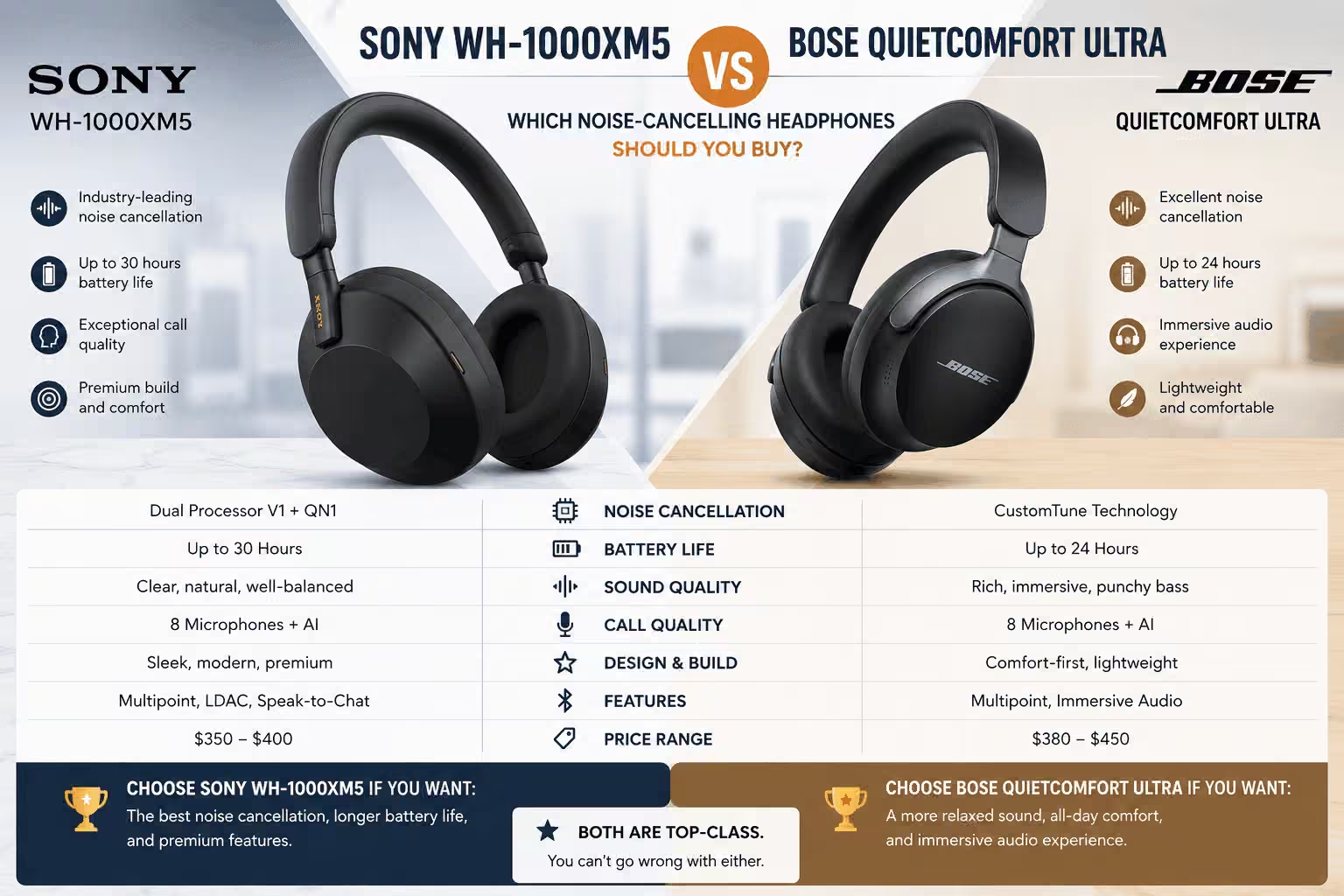
Sony's core differentiator is its LDAC codec and long-standing reputation for detailed, "fun" sound tuning combined with genuinely class-leading ANC hardware — Sony's official materials describe the WH-1000XM5 as using two processors driving eight microphones for noise cancellation, with an Auto NC Optimizer that adapts to your environment.
Bose's core differentiator is Immersive Audio — its take on spatial/head-tracked audio that works with any content, not just specially mastered tracks — combined with what independent reviewers consistently rate as superior physical comfort and build quality. The 2nd Gen Bose is also the only one of the two to offer genuinely lossless wired audio over USB-C.
Active Noise Cancellation (ANC)
RTINGS' lab comparison found the Bose Ultra Headphones to have a slight edge in noise isolation over the Sony XM5, though the difference is minor and both are well-suited for noisy environments.
This tracks with Sony's own related-product testing: SoundGuys measured the Sony WF-1000XM5 earbuds at roughly 87% average noise attenuation, versus about 83% for the Bose QC Ultra Earbuds — a reminder that ANC performance can vary meaningfully between a brand's earbud and over-ear lines, so headphone-specific test data is the more relevant source here.
Neither company publishes a standardized, third-party-verified decibel reduction figure for these exact models. Owner reports also mention situational ANC issues, like popping or crackling around bass and glasses seals.
Sound Quality
Independent measurement site Front Desk Review recorded the Sony WH-1000XM5 with an MDAQS overall score of 4.2 out of 5, with a Timbre score of 4.3 and a Distortion score of 3.6, noting it delivered a tangible benefit over previous WH-1000X models, including notably better low-end performance compared with Bose's Noise Cancelling Headphones 700.
On the Bose side, SoundGuys' comparison of the related earbud lines found the Bose QC Ultra Earbuds (2nd Gen) have a V-shaped signature with boosted bass and treble, while the Sony WF-1000XM5 has more upper-bass emphasis but maintains better clarity in the mids and highs with a wider soundstage — a pattern that broadly echoes what reviewers say about the over-ear models as well.
If you like a boosted, immersive low end, Bose tends to satisfy that preference; if you want more clarity and detail retrieval, reviewers more often point to Sony. Both companies offer in-app EQ adjustment, so out-of-the-box tuning differences can be reduced somewhat by users willing to tweak settings.
Battery Life
According to official specifications, the Sony WH-1000XM5 is rated for 30 hours with ANC on and 40 hours with ANC off. The original Bose QC Ultra is rated for 24 hours with ANC on, dropping to 18 hours with Immersive Audio engaged — a gap Tom's Guide specifically called out as "middling battery life for a flagship design."
The 2nd Gen Bose closes that gap significantly, with What Hi-Fi? reporting 30 hours with ANC on, 45 hours with ANC off — more or less matching the Sony XM6 — though Immersive Audio still drops the 2nd Gen's runtime to around 23 hours.
Real-world battery life depends heavily on volume level, codec choice (LDAC and aptX Adaptive both draw more power than SBC/AAC), and how often ANC or spatial audio modes are toggled.
Call Quality and Microphones
Sony's official materials describe the WH-1000XM5's call system as using Precise Voice Pickup Technology and four beamforming microphones working together to ensure clear voice capture, even in noisy environments. Tom's Guide specifically listed "stellar call quality" as a pro for the Sony.
We were not able to independently verify a directly comparable, methodology-matched call-quality test score for the Bose QC Ultra from the sources gathered. If call quality is a priority, we recommend checking a recent side-by-side mic-sample video or RTINGS' dedicated microphone testing for both models.
Comfort and Build Quality
This is one of the clearest, most consistently sourced differences in this comparison. RTINGS' direct lab comparison concluded the Bose QC Ultra Headphones are more comfortable and better built than the Sony WH-1000XM5.
However, comfort is highly individual — head size, glasses use, and ear shape all affect how any headphone clamps and seals. Some Bose owners report the opposite experience (over-clamping discomfort), covered in the Problems section below.
Codec and Wired Support
The Sony supports the LDAC codec (useful for high-resolution streaming on compatible Android devices) and can be used passively when wired — the cable works even with the headphones powered off. The Bose supports aptX Adaptive and requires the headphones to be powered on to use the wired connection.
The 2nd Gen Bose adds a meaningful upgrade: USB-C wired lossless CD-quality audio, something not possible over Bluetooth even with aptX Adaptive.