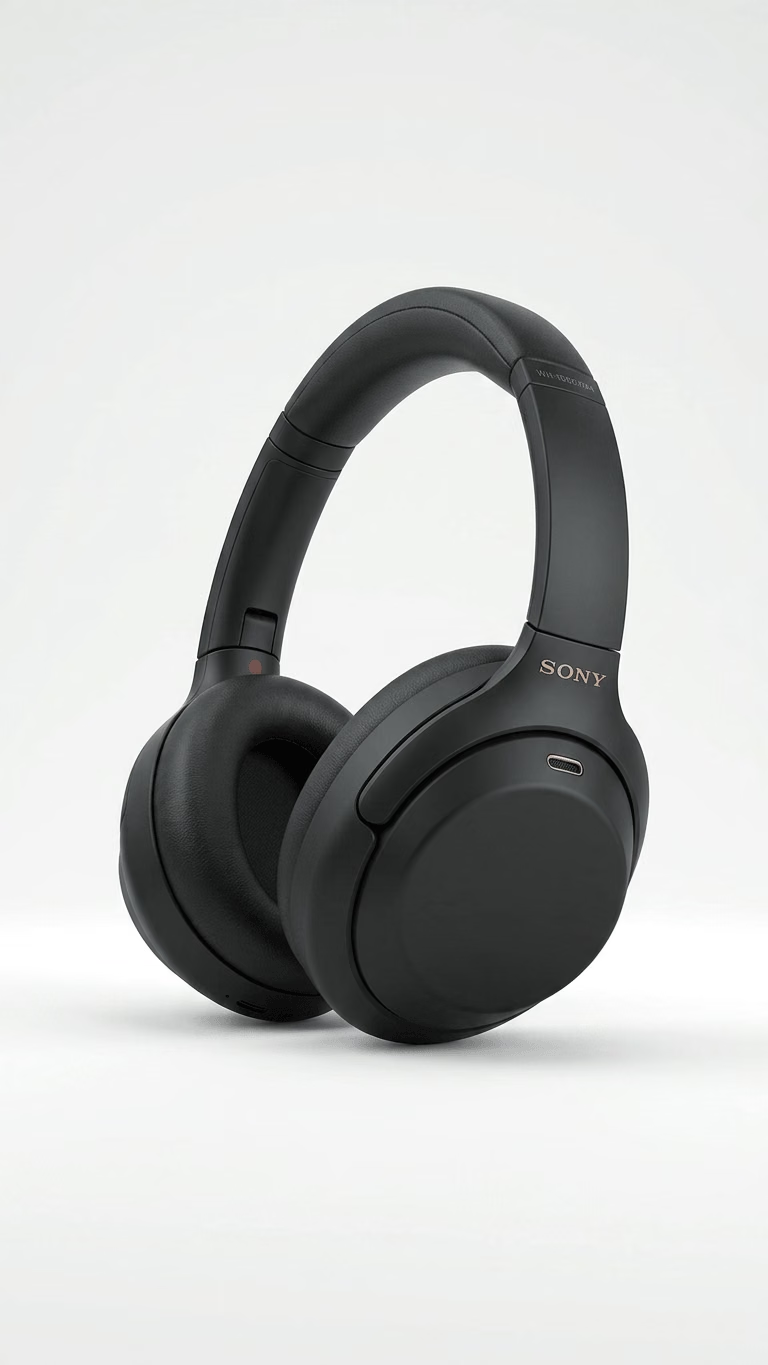
The Sony WH-1000XM4 is no longer Sony's newest flagship noise-canceling headphone. The WH-1000XM5 came after it, and the newer WH-1000XM6 now sits further up Sony's lineup.
So why are people still searching for the WH-1000XM4 in 2026?
Because the XM4 got many important things right: strong active noise cancellation, a comfortable and foldable design, useful smart features, LDAC support, multipoint Bluetooth, long battery life, and a sound profile that can be customized through Sony's app.
But there is an important question in 2026: Is the WH-1000XM4 still a smart buy, or should you spend more on a newer model?
If you already own one and it still works well, there is usually no urgent reason to replace it. If you are buying one today, however, the price matters more than ever because newer headphones offer improvements in areas such as noise cancellation, microphone performance, connectivity, and other features.
Important YallaBuy Transparency Note
YallaBuy did not physically test, purchase, unbox, or wear the Sony WH-1000XM4 for this review. We will never present another company's testing as our own. Instead, this article is a research-based buying guide built from Sony's official specifications, independent laboratory testing and measurements, reviews from established audio and technology publications, technical information from reliable sources, consumer feedback, and YallaBuy's own analysis of the available evidence.
When we say that Sony officially rates the headphones for a particular battery life or feature, that information comes from Sony. When we discuss independent measurements such as noise isolation, microphone performance, or frequency response, we identify those findings as independent testing. And when we give a buying recommendation, that is YallaBuy's analysis, not a claim that we personally tested the headphones.
This distinction matters.
Quick Verdict
The Sony WH-1000XM4 remains one of the more capable older premium ANC headphones you can buy. It is especially attractive for people who want: strong noise cancellation, comfortable long listening sessions, a foldable travel-friendly design, multipoint Bluetooth, LDAC support, a customizable sound profile, around 30 hours of rated battery life with noise cancellation enabled, and a mature and feature-rich companion app.
However, it is no longer the obvious choice for everyone. Newer headphones can provide better performance in specific areas. Independent testing shows that Sony's newer WH-1000XM6 has stronger noise cancellation in some mid-range frequencies and substantially better microphone performance than the XM4.
Buy the XM4 if:
- You find it at a significantly lower price than newer flagship models
- You prioritize comfort, ANC, and portability
- You want LDAC
- You want multipoint Bluetooth
- You like Sony's sound customization
- You do not need the newest features
Consider a newer model if:
- You want the best ANC Sony currently offers
- Call quality is extremely important
- You want newer hardware and longer-term ownership
- The price difference between the XM4 and a newer model is relatively small
If your battery is still healthy, the ear pads are in good condition, ANC works properly, and you are satisfied with its performance, keep it. You do not need to upgrade simply because newer headphones exist.
Key Specifications
| Feature | Sony WH-1000XM4 |
|---|---|
| Type | Closed-back wireless over-ear |
| Driver | 40mm |
| Bluetooth | Version 5.0 |
| Codecs | SBC, AAC, LDAC |
| Battery with ANC | Up to 30 hours |
| Battery without ANC | Up to 38 hours |
| Charging time | Approx. 3 hours |
| Connection | Bluetooth + 3.5mm wired |
| Multipoint | Yes |
| ANC | Yes |
| Ambient Sound Mode | Yes |
| Quick Attention | Yes |
| DSEE Extreme | Yes |
| Speak-to-Chat | Yes |
| Wearing detection | Yes |
| Foldable | Yes |
| NFC | Yes |
| Weight | Approximately 254g |
| App | Sony | Sound Connect |
Sony's official specifications list a 40mm driver, Bluetooth 5.0, SBC/AAC/LDAC support, up to 30 hours of playback with noise cancelling enabled, up to 38 hours with noise cancelling off, and approximately three hours for a full charge. Sony also lists multipoint, atmospheric-pressure optimization, ambient sound, Quick Attention, and DSEE Extreme among the features.
1. Design and Build Quality
The WH-1000XM4 uses a closed-back, over-ear design with a predominantly lightweight plastic construction.
It does not have the luxurious metal construction of something like the AirPods Max. But that is not necessarily a disadvantage. A lighter headphone can be much easier to wear for several hours.
The XM4 also uses a foldable swivel design, which is one of the reasons it remains particularly attractive for travel. Sony designed the earcups to rotate inward so the headphones can fit into their included carrying case.
Is the design still modern in 2026? Not particularly. The XM4 looks recognizable as an older Sony flagship. Newer headphones can have cleaner or more modern-looking designs. But the XM4's design has an important practical advantage: it is built around portability rather than visual luxury. For travelers, that can matter more than premium-looking materials.
2. Comfort
Comfort is one of the XM4's strongest characteristics. Independent testing from RTINGS describes the headphones as comfortable and particularly suitable for travel and office use. Their closed-back construction does trap some heat, however, which makes them less ideal for intense exercise.
The large earcups and padded headband help distribute pressure. For long flights, office work, studying, or commuting, the XM4 makes considerably more sense than headphones designed primarily for sports.
But comfort is not perfect. No headphone fits every person identically. Some users may find the earcups too shallow or experience heat buildup during long sessions. The closed-back construction also means your ears can become warmer than they would with a more breathable design.
Excellent for
- Flights
- Trains
- Office work
- Studying
- Long listening sessions
Less suitable for
- Running
- Heavy workouts
- Hot outdoor environments
3. Active Noise Cancellation
This is still one of the main reasons to consider the WH-1000XM4. The XM4 uses Sony's noise-cancellation hardware and processing system together with microphones to analyze external sound and generate the appropriate cancellation signal.
Sony also includes: Adaptive Sound Control, Personal Noise Cancelling Optimizer, Atmospheric Pressure Optimizing, Ambient Sound Mode, and Quick Attention. These features are part of what makes the XM4 more than a basic Bluetooth headphone.
How good is the ANC in 2026? Still very good. Independent testing by RTINGS finds the XM4 particularly effective at reducing external noise across the frequency range, with especially strong performance against bass-heavy sounds such as airplane-engine rumble.
That makes the XM4 particularly attractive for: airplane travel, bus and train commuting, air conditioners, low-frequency machinery, and office background noise.
However, it is important not to exaggerate what ANC can do. ANC does not make the outside world disappear. Sudden sounds, voices, and higher-frequency noises can still be audible. And newer headphones have improved in some of these areas.
For example, RTINGS' current comparison between the XM4 and XM6 reports that the XM6 provides noticeably stronger ANC in the mid-range, particularly for background chatter in places such as cafes and open offices.
4. Sound Quality
The XM4 has never been designed around a strict studio-neutral sound. Its sound is better described as warm and bass-emphasized. Independent measurements from RTINGS characterize the XM4's sound signature as warm, with noticeably emphasized bass.
That can work extremely well for: hip-hop, EDM, pop, electronic music, movies, gaming, and casual listening. But listeners who prefer a highly neutral presentation may want something different.
The bass is one of the XM4's defining characteristics. It provides impact and warmth, but some listeners may find it excessive. That is where Sony's EQ becomes important.
The Sony app provides sound customization, allowing listeners to adjust the headphone's sound rather than being locked into the factory tuning. Sony also includes DSEE Extreme, which is designed to process compressed music and restore some high-frequency information.
Can EQ improve the XM4? Yes. This is one of the headphone's biggest advantages. Instead of judging the XM4 only from its factory tuning, users can adjust the sound according to their preferences. A listener who finds the bass too strong can reduce it. Someone who wants more presence in vocals can increase the appropriate frequencies. That flexibility gives the XM4 more longevity than a headphone with a fixed sound signature.
5. LDAC and High-Resolution Bluetooth
One of the XM4's important advantages is LDAC. Sony's official specifications list SBC, AAC, and LDAC as supported Bluetooth audio formats. Sony states that LDAC can transmit up to 990 kbps and is designed to carry considerably more audio data than conventional Bluetooth audio.
However, there is an important distinction: higher bitrate does not automatically mean that every listener will hear a dramatic improvement. Your source, device, settings, environment, and listening material all matter.
Android users with LDAC-compatible devices can take advantage of this feature. iPhone users do not get LDAC support, so the XM4's codec advantage is different on Apple's platform.
6. Microphone and Call Quality
This is an area where we need to correct a common misconception. The XM4 has multiple microphones and Sony's Precise Voice Pickup Technology. Sony describes the system as using five microphones together with signal processing to improve voice pickup.
But having five microphones does not automatically mean the XM4 has excellent call quality. Independent testing tells a more nuanced story.
RTINGS currently describes the XM4's microphone performance as disappointing, noting that voices can sound thin and muffled and that background-noise isolation is not especially strong. That is an important consideration.
For occasional calls, the XM4 is usable. For constant professional calls, we would not choose it primarily because of its microphone. If microphone quality is one of your highest priorities, newer headphones such as the XM6 have a clear advantage according to current independent testing.
7. Battery Life
Battery life remains one of the XM4's strengths. Sony officially rates it for up to 30 hours with noise cancellation ON and up to 38 hours with noise cancellation OFF. Sony lists approximately three hours for a full charge.
Independent testing has also found battery endurance to be strong, with RTINGS reporting more than 37 hours of continuous battery life in its testing conditions.
Of course, actual battery life varies with: volume, codec, ANC, Ambient Sound, calling, DSEE Extreme, other settings, and battery age.
This is especially important if you buy an older or refurbished XM4. A brand-new XM4 and a heavily used XM4 from 2020 are not necessarily going to deliver the same battery endurance. Lithium-ion batteries naturally lose capacity over time. So when buying a used or renewed XM4, battery condition should be part of your decision.
8. Smart Features
The XM4 was unusually feature-rich when it launched, and many of those features remain useful.
Wearing Detection
The proximity sensor can detect when the headphones are removed and automatically pause playback. Sony officially describes this feature as part of the XM4's smart functionality.
Speak-to-Chat
Speak-to-Chat detects when you begin talking and can automatically pause or reduce your music while allowing ambient sound through. Sony states that the default resume time is approximately 30 seconds after the conversation ends, and this timing can be customized in the app. The feature is useful, but not everyone likes it. Some users can trigger it unintentionally when speaking, singing, coughing, or making other sounds. Sony even provides troubleshooting guidance for cases where Speak-to-Chat activates unexpectedly. Fortunately, the feature can be disabled.
Quick Attention
Place your hand over the appropriate earcup and the headphone temporarily reduces music volume and allows ambient sound through. This is useful when you need to hear an announcement or quickly speak to someone without removing the headphones.
9. Multipoint Bluetooth
Multipoint is one of the XM4's best practical features. The headphones can connect to two Bluetooth devices simultaneously. For example: laptop + smartphone. You can listen to music from your laptop while remaining connected to your phone. When a call arrives, you can switch to the phone and then return to the computer afterward.
Sony's current support documentation confirms that the XM4 supports simultaneous connection to two Bluetooth devices. There is one limitation: two devices, not an unlimited number of active connections. For students and office workers, this remains a very useful feature.
10. Sony's Companion App
The software experience is another reason the XM4 has aged well. Sony's current app ecosystem allows users to control and customize headphone features. Depending on the feature and software version, users can configure things such as: equalizer, ambient sound, ANC behavior, touch controls, Speak-to-Chat, multipoint, and other device settings.
Sony continues to provide support resources for the XM4, including firmware and software information. Sony's support page currently lists firmware version 3.0.1 released in October 2025 and the Sony | Sound Connect app updates in 2026. That continued support is useful for owners in 2026.
11. Connectivity
The XM4 uses Bluetooth 5.0. Supported Bluetooth audio codecs are SBC, AAC, and LDAC. Sony lists an effective Bluetooth range of approximately 10 meters / 30 feet under line-of-sight conditions. The headphones also include a 3.5mm connection and support passive operation. This gives the XM4 flexibility that some newer wireless headphones do not prioritize.
12. Travel Performance
If you travel frequently, the XM4 remains extremely compelling. You get: strong ANC, foldable design, carrying case, long battery life, comfortable fit, Quick Attention, Ambient Sound, wired fallback, and multipoint.
RTINGS specifically recommends the XM4 for travel and commuting, citing its comfort, ANC, carrying case, and battery performance. The XM4 also includes atmospheric-pressure optimization, a feature Sony designed with air travel in mind.
13. Office and Study Performance
For studying or office work, the XM4 makes a lot of sense. Its ANC can reduce distracting background noise, while multipoint lets you remain connected to both your computer and phone. RTINGS similarly rates the XM4 highly for office use, while noting that some audio leakage can occur at high listening volumes.
ANC should not be treated as a substitute for situational awareness. When walking near traffic or in other potentially dangerous environments, use ambient mode or remove the headphones when appropriate.
14. Gaming
The XM4 can work for wired gaming because it has a 3.5mm connection. However, wireless gaming is not its strongest use case. RTINGS reports that Bluetooth latency can be too high for gaming where synchronization between sound and video matters, and the headphone does not provide the same console-focused wireless compatibility as dedicated gaming headsets.
15. Sony WH-1000XM4 vs WH-1000XM5
The XM5 is newer and improves several aspects of the Sony formula. Sony's official specifications show the XM5 has Bluetooth 5.2, up to 30 hours with ANC, up to 40 hours without ANC, LDAC, a lighter approximately 250g listed weight, and updated noise-cancellation hardware.
But the XM4 still has an important practical advantage: the XM4 folds. The XM4 also remains attractive when its price is significantly lower.
Choose XM4 if:
- It is considerably cheaper
- You prefer the folding design
- You want strong ANC and LDAC without paying for the newest generation
Choose XM5 if:
- The price difference is small
- You want newer hardware
- You prefer the newer design and improvements
16. Sony WH-1000XM4 vs WH-1000XM6
This is the more important comparison in 2026. The XM6 is two generations newer than the XM4. Independent testing currently gives the XM6 meaningful advantages in several areas.
RTINGS reports that the XM6 has stronger ANC performance in mid-range frequencies, particularly against background chatter, and significantly better microphone performance. It also adds newer features and connectivity improvements.
XM4 Advantages
- Usually more attractive when heavily discounted
- Proven design
- Foldable
- Comfortable
- LDAC
- Multipoint
- Strong ANC
- Mature software ecosystem
XM6 Advantages
- Newer hardware
- Better ANC in important mid-frequency situations
- Better microphone performance
- Newer features
- Better long-term choice if the price difference is acceptable
17. Sony WH-1000XM4 vs Bose QuietComfort
The current Bose QuietComfort remains a major competitor. Bose officially rates its QuietComfort headphones for up to 24 hours of battery life and emphasizes comfort, customizable listening modes, ANC, and adjustable EQ. RTINGS' current comparison finds that the XM4 is more feature-rich and provides stronger noise blocking in its testing, while both headphones have warm sound signatures.
Choose Sony XM4 for:
- LDAC
- More software customization
- Strong ANC
- Multipoint
- Sony's feature ecosystem
Choose Bose QC for:
- Bose's comfort-focused design
- Physical controls
- Bose's listening modes
- Users who prefer Bose's sound and ergonomics
18. Sony WH-1000XM4 vs Sennheiser Momentum 4
This is a particularly interesting comparison. The Momentum 4 is designed with a stronger emphasis on battery life and sound. Sennheiser officially lists up to 60 hours of battery life for the Momentum 4, including Bluetooth playback with ANC under its stated test conditions. That is dramatically longer than Sony's official 30-hour ANC rating.
XM4 Advantages
- Stronger ANC reputation
- Excellent travel performance
- Mature smart features
- LDAC
- Foldable design
Momentum 4 Advantages
- Much longer battery life
- Strong audio performance
- Excellent value when discounted
19. What About the AirPods Max?
The AirPods Max is a very different product philosophy. Apple emphasizes premium materials and deep integration with its ecosystem. The XM4 is lighter, more compact, and much more focused on traditional Bluetooth flexibility.
For iPhone users who are deeply invested in Apple's ecosystem, AirPods Max can have advantages. But if your priorities are: lower weight, foldability, LDAC on compatible devices, broader Bluetooth flexibility, and lower potential cost — the XM4 is a much more practical design.
20. Pros and Cons
- Excellent ANC for its generation
- Particularly strong at reducing low-frequency environmental noise
- Comfortable for long listening sessions
- Foldable travel-friendly design
- Up to 30 hours of rated battery life with ANC
- Up to 38 hours with ANC disabled
- LDAC support
- AAC and SBC support
- Multipoint Bluetooth
- Speak-to-Chat
- Wearing detection
- Quick Attention
- Adaptive Sound Control
- DSEE Extreme
- Customizable sound through Sony's app
- Wired 3.5mm connection
- Mature software and support ecosystem
- Microphone performance is not class-leading
- Newer Sony models provide better ANC in some situations
- Newer models provide better call performance
- Sound is bass-heavy for listeners who prefer neutral tuning
- Closed-back design can trap heat
- Older units may have reduced battery capacity
- Ear-pad material can wear over time
- Not designed primarily for sports
- Bluetooth latency makes it less suitable for competitive gaming
- It is no longer the newest Sony flagship
- Its value depends heavily on the current selling price
21. Is the Sony WH-1000XM4 Still Worth Buying in 2026?
Yes — with one major condition.
The price must be right. That is the central point of this entire review.
The XM4 was originally a premium flagship. Today, it is an older product competing against newer headphones. That changes the buying equation.
You should not ask: "Was the XM4 one of the best headphones when it launched?" The answer to that historical question does not determine whether it is a good purchase today.
Instead, ask: "What am I paying for the XM4 compared with the newer alternatives available today?"
That is the correct 2026 buying question.
22. Should Existing XM4 Owners Upgrade?
For most owners: No.
If your XM4 still has good battery life, still fits comfortably, has working ANC, has healthy ear pads, and sounds good to you — there is no technological emergency requiring an upgrade. The XM4 still provides the core experience many people actually want: wireless audio + ANC + comfort + battery + smart features.
Upgrade to XM6 if: you want better ANC, you make lots of calls, you want newer features, you want the latest Sony platform, and you can afford the price difference.
Keep the XM4 if: you are happy with its sound, ANC is already good enough, battery life is still healthy, you mainly use it for travel and studying, and the XM6 would be an expensive upgrade for relatively small personal benefit.
23. Who Should Buy the Sony WH-1000XM4?
1. Frequent Travelers — Excellent
The combination of ANC, comfort, battery life, and foldability makes the XM4 particularly suitable for flights and commuting.
2. Students — Excellent
The XM4 can help create a quieter environment for studying, especially in noisy public spaces.
3. Office Workers — Excellent
Multipoint is particularly useful when switching between a computer and phone.
4. Music Listeners — Very Good
The warm sound and EQ flexibility make the XM4 enjoyable for many mainstream genres.
5. Audiophiles — Good
It is capable, but it is not a true wired audiophile reference headphone. If absolute sound fidelity is your only priority, there are better choices.
6. Athletes — Limited
Not recommended as a primary workout headphone. Independent testing notes that the headphones can move during more intense exercise and their closed-back construction can trap heat.
24. Buying Used or Renewed in 2026
This is where buyers need to be careful. Because the XM4 is an older generation, used and refurbished examples can be attractive. But condition matters.
Before buying a used unit, check:
- Battery: Ask whether the battery still provides reasonable playback time.
- Ear Pads: Check for peeling, cracking, flattening, or excessive wear.
- Hinges: Open and close both sides carefully.
- ANC: Make sure ANC and Ambient Sound work correctly.
- Touch controls: Test volume, playback, and Quick Attention.
- Sensors: Check whether removing the headphones pauses playback as expected.
- Bluetooth: Test pairing and multipoint if that feature is important to you.
- Seller: Pay attention to seller reputation, return policy, warranty, product condition, and authenticity.
A cheap XM4 is not automatically a good deal if the battery is badly degraded or the headphones are counterfeit.
25. What Price Makes the XM4 Worth It?
There is no single permanent "correct" price for the XM4 because the market changes. Amazon and other retailers can change prices based on inventory, seller competition, promotions, and availability.
For that reason, YallaBuy does not recommend treating an old price from a previous article as today's price. Instead, use this decision rule:
Before buying, always check the current listing, seller, warranty, and return policy. The price displayed on a shopping page can change after this article is published. Always check the live price before purchasing.
26. YallaBuy Final Score
Rather than pretending that our scores come from physical testing, these scores represent our research-based buying assessment.
| Category | YallaBuy Assessment |
|---|---|
| Noise Cancellation | 9/10 |
| Comfort | 9/10 |
| Sound Quality | 8/10 |
| Battery | 9/10 |
| Features | 9/10 |
| Connectivity | 9/10 |
| Microphone | 6.5/10 |
| Portability | 9/10 |
| Value in 2026 | 8.5/10* |
| Overall Research-Based Score | 8.5/10 |
*Value depends heavily on the current market price. We intentionally do not give the XM4 a 10/10 simply because it was an excellent headphone. A 2026 rating must account for the products available in 2026.
27. Final Verdict
The Sony WH-1000XM4 has aged surprisingly well. Its strongest characteristics are still relevant: excellent ANC, comfort, battery life, LDAC, multipoint, portability, and extensive software features. Independent testing confirms that the XM4 remains strong for travel and office use and provides excellent noise isolation.
But it is important to recognize where newer headphones have moved ahead. The XM6 offers stronger noise cancellation in some important frequency ranges and better microphone performance according to current independent comparisons.
That means the XM4's biggest advantage in 2026 is no longer being "the best." Its biggest advantage is: Value.
If you can get the XM4 at a substantially lower price than a newer flagship, it can still be an excellent purchase. If the price difference is small, the newer model becomes much easier to recommend.
Already own the Sony WH-1000XM4? Keep it if it still works well.
Found a heavily discounted XM4? Consider buying it.
XM4 and newer Sony model are almost the same price? Buy the newer model.
Your priority is the best possible ANC? Look at the newer Sony flagship.
Your priority is battery life? Consider alternatives such as the Sennheiser Momentum 4, which Sennheiser rates for up to 60 hours.
Your priority is microphone performance? Look beyond the XM4.
Your priority is travel? The XM4 remains an excellent option.