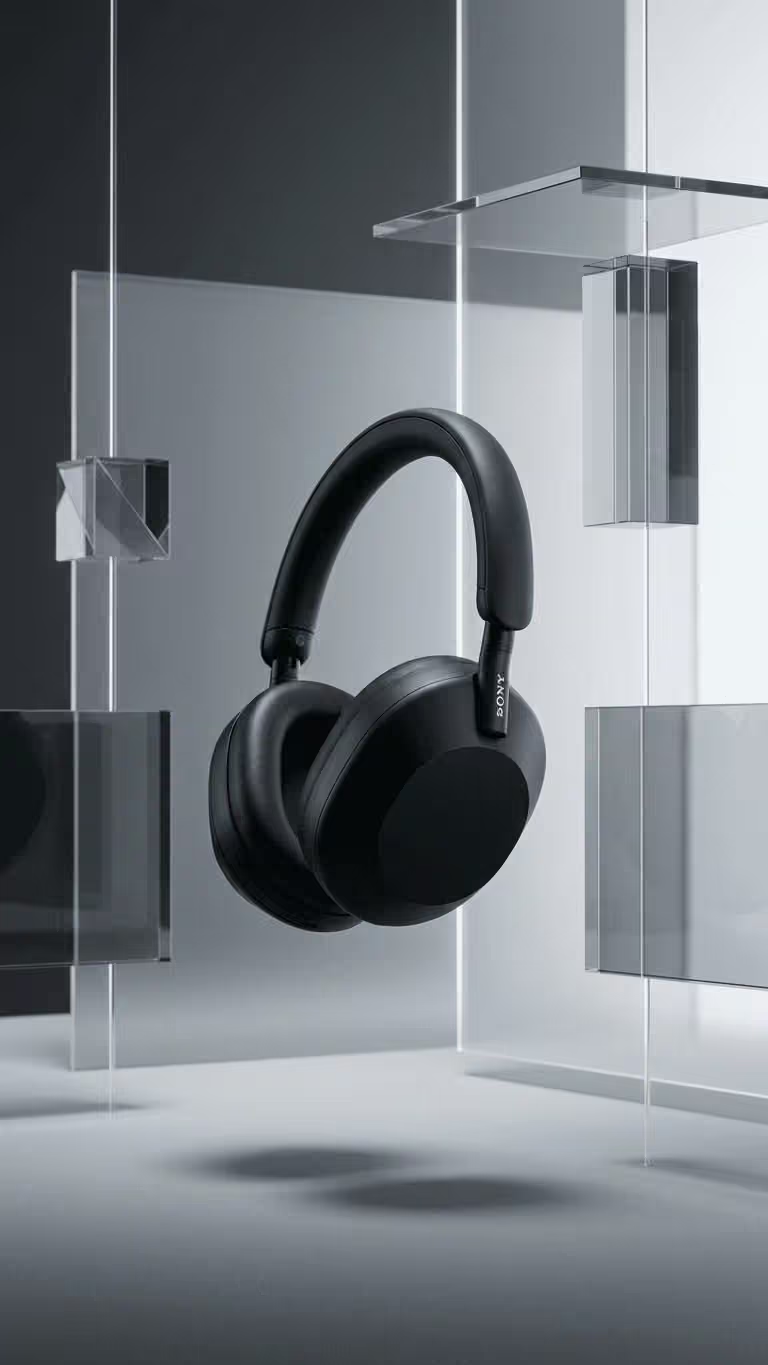
Quick Answer: The Sony WH-1000XM5 still deliver some of the best noise cancellation and call quality in wireless headphones, and independent testing backs that up. But three things regularly show up in the buyer's-remorse pile: a hinge that a documented share of owners report breaking, a redesigned case that doesn't fold small, and zero water resistance. At full price, with a direct successor already on shelves, it's worth knowing what you're accepting before you pay.
Quick Facts
| Launch price / date | $399.99, May 2022 |
| Current street price | Frequently $198–$298, varies by retailer and date |
| Weight | ~250–251g (measured) |
| Battery (ANC on) | Sony claims 30 hours; SoundGuys measured 31h 53m |
| Battery (ANC off) | Sony lists "up to 40 hours" — treat as approximate |
| Bluetooth | 5.2, with SBC, AAC, LDAC (no aptX) |
| Water resistance | None — no IP rating at all |
| Warranty | 1-year limited (US) |
| Successor | WH-1000XM6, launched May 15, 2025 at $449.99 |
1. The Hinge Failure Problem Is Real, Documented, and Now in Federal Court
This is the single most important thing to know before buying, and it's the one most XM5 marketing and even many reviews gloss over.
What's documented: In November 2025, a consumer named Ian Kanter filed a federal class action against Sony Corporation of America and Sony Electronics (Kanter v. Sony Corporation of America, Case No. 1:25-cv-09691, U.S. District Court for the Southern District of New York). The complaint alleges that the plastic hinge mounting points connecting the earcups to the headband are prone to cracking and detaching under normal use, and that Sony routinely classified these failures as "accidental physical damage" to deny warranty coverage rather than treating them as a manufacturing defect, according to court filings reported by TopClassActions and OpenClassActions.
In April 2026, a federal judge granted Sony's motion to compel arbitration and stayed the case. No class has been certified, Sony has not admitted wrongdoing, and the underlying allegations remain legally unproven — but the practical effect is that a class-wide resolution is no longer possible, and any owner with a hinge failure who wants to dispute a denied warranty claim now faces individual arbitration rather than a group lawsuit.
Separately, a February 2025 SoundGuys reader poll of roughly 2,000 XM5 owners found that 47% had experienced some form of hardware failure, and 24% — close to one in four respondents — specifically reported a hinge failure. A reader poll is not a controlled failure-rate study and shouldn't be read as "1 in 4 units will break." But it is a large enough, specific enough sample to treat the hinge issue as a recurring, verified concern rather than a handful of isolated complaints.
This pattern also shows up independently across retailer reviews. Multiple verified purchasers on Adorama's used-XM5 listings describe the earcup hinge separating from the headband within months of normal use. Slickdeals forum threads about XM5 deals consistently include warnings about "the notorious hinge issue" from commenters unprompted — a level of repetition across independent, unrelated communities that YallaBuy considers strong evidence of a recurring pattern.
What repair actually costs
Several verified Adorama reviewers who went through Sony's process after a hinge failure describe being quoted third-party repair costs in the $99–$109 range, or being offered a discounted replacement unit priced close to half the original purchase cost, rather than a free warranty repair. One reviewer described being told the choice was to pay more than they originally spent for a new pair, or pay roughly half the original price to have the existing pair repaired — after the failure occurred within months of normal, undamaged use.
YallaBuy analysis
This doesn't mean every unit fails, and long-term owners exist who've had zero problems. But if you buy the XM5 today, go in aware that (1) hinge failure is one of the most consistently reported issues with this specific headphone, (2) your one-year warranty may not automatically cover it if Sony's support labels it physical damage, and (3) your legal recourse if that happens is now individual arbitration, not a class action.
Practical steps to reduce risk: register the product with Sony immediately, photograph it in new condition as a dated record, avoid removing or replacing the headphones by pulling on a single earcup, don't force the earcups past their natural swivel range when packing them, and consider buying through a retailer such as Costco that several deal-thread commenters specifically recommend for its longer independent return window.
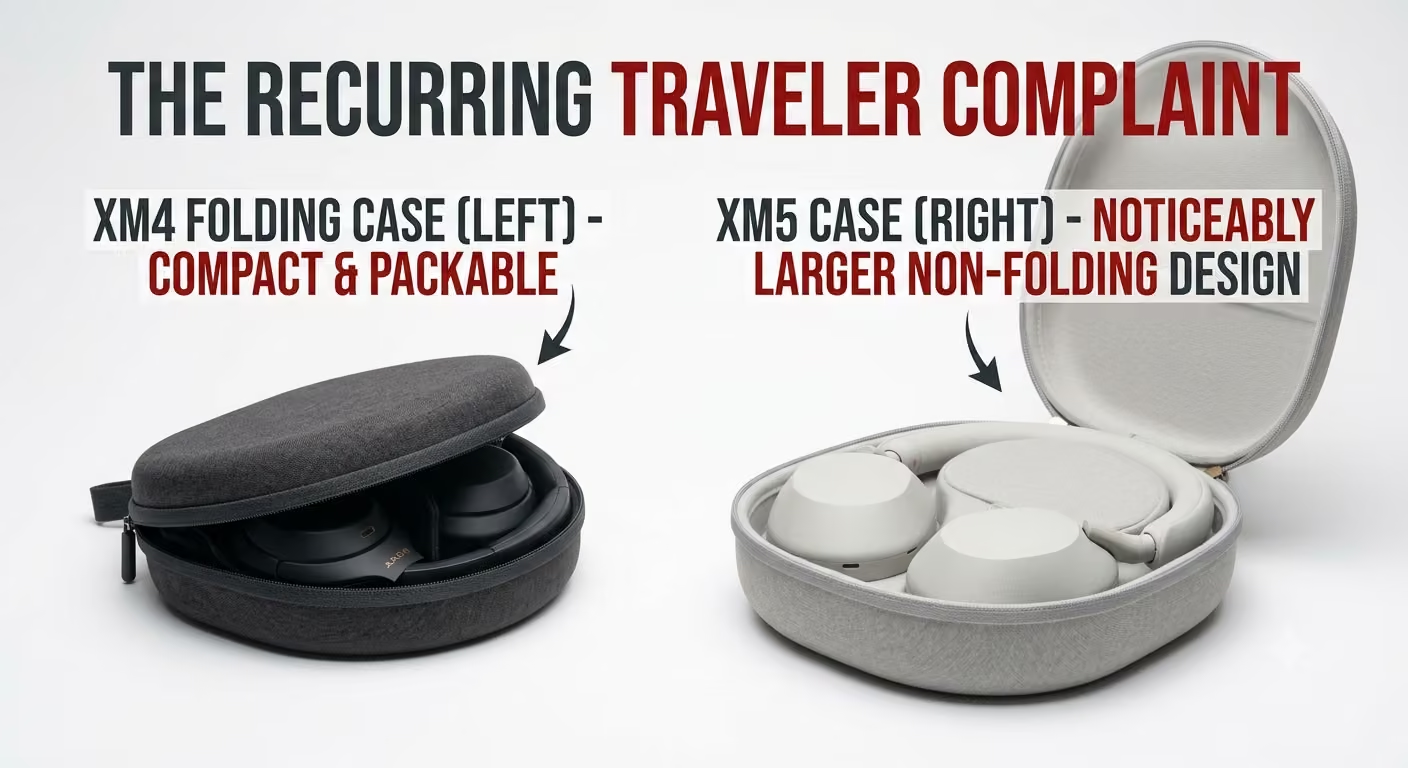
2. They Don't Fold Small Anymore — the Case Is Nearly Twice the Size of the XM4's
Every prior generation in this line folded flat into a compact case. The XM5 changed that: the earcups swivel flat, but the headband itself no longer folds inward, according to What Hi-Fi's and Galaxus's testing at launch. One outlet that measured both cases directly (Price.Review) found the XM5's case at roughly 25cm × 19cm versus the XM4's 18cm × 15cm — nearly double the footprint.
This matters specifically for frequent flyers and commuters who carry the case daily in a backpack, laptop bag, or purse — the use case Sony markets these headphones for most heavily. If packability is a priority, this is worth testing in person before buying, since it won't show up in most spec sheets.
For what it's worth, Sony reversed this decision with the WH-1000XM6, which reintroduces a folding hinge with metal reinforcement — an implicit acknowledgment that the XM5's non-folding design was a step back for a meaningful share of buyers.
3. There's No Water or Sweat Resistance — Not Even a Splash Rating
The WH-1000XM5 carries no IP rating of any kind. What Hi-Fi's review states plainly that the headphones aren't waterproof or sweat-resistant, and multiple retailer buying guides confirm the same: no protection against rain, humidity, or workout sweat.
Practically, this means: don't wear them running or in the gym, don't get caught in the rain with them on, and be cautious in humid climates where condensation inside the earcups is plausible over time. If you want ANC headphones for workouts, this isn't the product — look at Sony's own WF-1000XM5 earbuds, rated IPX4, or dedicated sport earbuds instead.
4. The One-Year Warranty Has Specific Gaps — Especially Around the Hinge
Sony's standard US warranty on the WH-1000XM5 runs one year, consistent with typical consumer electronics coverage. The relevant catch, based on the lawsuit and repeated owner reports, is how Sony's support process classifies hinge cracks: as "physical damage" rather than a materials or workmanship defect, according to the complaint detailed by TopClassActions and corroborated by multiple Adorama customer reviews describing the same experience firsthand — being asked to pay for third-party repair (commonly cited around $99–$109) rather than receiving warranty service.
If you buy the XM5, it's worth registering the product with Sony immediately after purchase, keeping your receipt and box, and — if a hinge issue does appear — documenting it with photos and a written support request rather than only a phone call, since several reviewers noted written correspondence helped their case.
5. LDAC and Multipoint Don't Always Work Together, and iPhone Users Lose LDAC Entirely
The XM5 supports SBC, AAC, and Sony's own LDAC codec for higher-bitrate wireless audio — but LDAC is not part of the Bluetooth standard and iOS does not support it at the operating-system level, so iPhone users are limited to AAC regardless of which headphones they buy. This is a general iOS limitation rather than something specific to Sony's hardware, but it's easy to miss if you're comparing "LDAC support" as a headline feature and using an iPhone.
For Android users, there's a second wrinkle: at launch, LDAC wasn't available while using Bluetooth Multipoint (connecting to two devices simultaneously, like a laptop and a phone). Sony has since enabled LDAC over multipoint connections through firmware updates — but this means the feature set you get depends on which firmware version is currently installed, and older units or ones that haven't been updated through the Sony Sound Connect app may not have it.
6. The Default Sound Signature Needs EQ — It's Not "Reference Flat" Out of the Box
Independent testing describes the WH-1000XM5's stock tuning as bass-forward and somewhat "muddy" by default, with treble that can sound dulled without adjustment — a description used independently by both TechGearLab and Headphonesaddict.com, and echoed by The Front Desk Review's measured MDAQS timbre score of 4.3 out of 5 with a compressed-sounding low end without EQ.
Every one of these sources notes the same fix: applying EQ through the Sony Sound Connect app substantially improves clarity, particularly in the low-mid range and vocals.
This isn't a defect — many mainstream consumer headphones ship with a bass-emphasized default tuning because that's what most casual listeners prefer out of the box. But if you're buying the XM5 specifically because you've read "excellent sound quality" in a review, know that a meaningful share of that quality is unlocked through the app's EQ, not the factory default.
7. The WH-1000XM6 Already Exists — and Directly Addresses Several Items on This List
Sony released the WH-1000XM6 on May 15, 2025, at a launch price of $449.99. The XM6 uses a newer QN3 noise-canceling processor (up from the XM5's QN1), expands the microphone array, reintroduces a folding headband hinge built with metal reinforcement, and extends rated battery life to roughly 37 hours with ANC active — directly targeting three of the complaints on this list.
Important caveat: the redesigned XM6 hinge has its own early reports of trouble. According to BigGo Finance's coverage, at least 13 Reddit users had documented a cracking plastic ring above the new metal hinge as of early August 2026, with a community tracker cited by SoundGuys counting 17 related threads across the XM6's roughly 14-month lifespan. The metal hinge itself is reportedly holding up, but a surrounding plastic component is failing in a similar pattern to the XM5's original problem. No comparable class action has been filed over the XM6 as of this writing.
XM5 vs XM6 Comparison
| Spec | WH-1000XM5 | WH-1000XM6 |
|---|---|---|
| Launch price | $399.99 (May 2022) | $449.99 (May 2025) |
| Processor | Single QN1 chip, dual-processor ANC, 8 mics | Newer QN3 chip, 12 mics |
| Folds for travel | No — cups swivel flat only; larger case | Yes — folding hinge with metal reinforcement |
| Battery (ANC on) | ~30 hours (31h 53m measured) | ~37 hours (manufacturer figure) |
| Water resistance | None | None confirmed |
| Documented hinge concern | Yes — federal lawsuit, large owner poll, repeated reports | Early-stage reports of cracking plastic ring; smaller sample |
| Typical current price | Often $198–$298 | Often $378–$420 |
8. Fit and Comfort Are Not Universal — Smaller Heads Report Issues
TechGearLab's testing specifically flags that the fit can be uncomfortable for smaller heads, and multiple Adorama customer reviews independently describe the headband as uncomfortable after roughly 30 minutes of wear, alongside complaints about "delicate" hinges — the two complaints often appearing in the same reviews, suggesting the thinner, lighter headband redesign trades some structural robustness and universal comfort for reduced weight.
On the positive side, several retailer reviews describe the earcup padding as deep and soft enough to comfortably fit larger ears, and most users across review platforms rate long-session comfort positively.
The practical takeaway: comfort with this specific headband design is more head-shape-dependent than with some competitors. If possible, try them on in a store before buying, especially if you've found other over-ear headphones uncomfortable in the past.
9. The $399.99 List Price Is Effectively Fictional — Almost Nobody Pays It
Since launch, the WH-1000XM5 has been discounted so frequently and so deeply that the official list price functions more as a reference point than a real transaction price. Tom's Guide has documented multiple "lowest price ever" drops over the product's lifetime — $348, then $249, then further — and by mid-to-late 2026, the XM5 hit $198 during Prime Day in June 2026 and matched that same $198 low again over Labor Day weekend in September 2026.
YallaBuy analysis: If you're seeing the XM5 listed anywhere close to $399, wait — deep, repeated discounting has been the norm for this product for most of its life, not the exception. Remember that prices shift daily and by retailer; treat any specific number in this article as historical reference rather than today's price.
10. You Need the App for Multipoint, Full Codec Support, and Firmware Updates
Basic playback, ANC toggling, and touch controls work without installing anything. But several of the XM5's most-marketed features are locked behind the Sony Sound Connect app: enabling Bluetooth Multipoint, accessing LDAC and its interaction with multipoint, customizing the EQ discussed in point 6, and installing firmware updates (including the ones that added or fixed multipoint/LDAC behavior after launch).
If you were planning to use these headphones purely paired to one device with zero app installed, know upfront that you'll be leaving real functionality — and, per point 6, real sound quality — on the table.
What the WH-1000XM5 Actually Gets Right
It's worth balancing the list above with what independent testing consistently praises, since a "before you buy" article that only lists downsides would be just as misleading as one that only lists strengths.
Noise cancellation
TechGearLab's measured testing found the ANC blocks roughly 31 decibels of outside noise, which the outlet rates among the best results in its test pool, driven by the eight-microphone, dual-processor setup. SoundGuys independently found a similar pattern — a meaningful step up in overall noise attenuation compared with the prior-generation XM4, particularly in low-frequency isolation.
Call quality
Multiple outlets, including Android Police and Tom's Guide, specifically call out call clarity as a standout feature, attributing it to the eight-microphone array's ability to isolate a caller's voice from background noise. This is consistently one of the least-disputed strengths across independent sources.
Battery life
SoundGuys' controlled testing measured 31 hours and 53 minutes with ANC on — slightly exceeding Sony's own 30-hour claim — and 53 hours and 6 minutes with ANC off, an unusually large gap between the two modes.
Quick charge
Independent testing and Sony's own specifications agree: roughly three hours of playback from a three-minute charge over USB-C with a compatible USB-PD charger, useful if you regularly find yourself with a nearly dead battery before a flight or commute.
Common Buying Mistakes to Avoid
- Paying list price without checking recent price history. The XM5 has spent most of its lifetime on sale; buying at $399.99 typically means overpaying.
- Skipping app setup. Leaving the companion app uninstalled means missing multipoint, EQ, and firmware updates — all of which change the actual sound and feature set you experience.
- Buying used or through unofficial third-party sellers expecting full warranty coverage. Sony's warranty support can be inconsistent for units purchased through resellers not on Sony's authorized list.
- Assuming "noise cancelling headphones" means "workout headphones." Given the complete lack of an IP rating, treating these as gym or running headphones is one of the more common regrets described in negative reviews.
- Judging sound quality on the first ten minutes out of the box. The stock tuning is bass-forward by design; several independent reviewers specifically recommend spending time with the EQ before forming a final opinion.
Who Should and Shouldn't Buy the WH-1000XM5
- Prioritizing noise cancellation and call quality over folding convenience
- Anyone who found the XM4 too bulky-sounding and wants a leaner tuning (with EQ)
- Budget-conscious buyers comparing against the XM6 ($150–$200 less)
- Commuters and office users not exposed to rain or heavy sweat
- Buyers willing to register the product, handle the hinge carefully, and use the companion app
- Frequent flyers or travelers who need a genuinely compact folding case
- Anyone exercising, running, or working in humid/wet conditions
- Buyers who specifically want IP-rated durability
- iPhone-only users buying primarily for LDAC — that codec doesn't apply to you
- Buyers who won't install a companion app and expect full features out of the box
Alternatives Worth Considering
Sony WH-1000XM6
The direct successor — folds again, uses a newer QN3 processor with a larger 12-microphone array, and rates for longer battery life with ANC active. Costs roughly $80–$120 more at typical discounted prices and has its own early, smaller-scale hinge-adjacent reports. Best for buyers who specifically want a folding case and don't mind paying the premium.
Sony WH-1000XM4
The previous generation. Independent testing generally rates its ANC and audio quality slightly behind the XM5, but it folds fully into a compact case and is typically the least expensive option across this three-generation lineup when discounted. A reasonable pick if your main complaint about the XM5 is the case size.
Bose QuietComfort Ultra Headphones
The most frequently cited head-to-head comparison in this price bracket. Reviewers commonly describe Bose's tuning as more neutral and its clamping force as gentler, which can matter for the smaller-head comfort concern. Battery life is typically shorter than the XM5's. Consider if comfort and neutral sound matter more than battery life.
Sony WF-1000XM5
Sony's flagship earbuds carry an IPX4 water-resistance rating, directly addressing the water-resistance gap, at the cost of over-ear comfort and the XM5's much longer per-charge battery life. Worth considering if workouts, commuting in variable weather, or portability outweigh long-session comfort.
Value for Money
Good Value at DiscountAt the WH-1000XM5's frequent discounted price range (commonly $198–$298), independent testing consistently rates the ANC and call quality as class-leading or near it, which supports strong value at that price band. At the full $399.99 list price, the calculation is less favorable, given (1) the WH-1000XM6 exists at a moderate premium with meaningful upgrades, and (2) the documented hinge concern introduces a real chance of an out-of-warranty repair cost during ownership.
YallaBuy's assessment is that this product's value depends heavily on paying a discounted price rather than list price — check current pricing before deciding.
Final Verdict
The Sony WH-1000XM5 remain genuinely strong-performing headphones by the measures independent testers use most: noise cancellation, call quality, and comfort for most head shapes. They are not, however, a flawless purchase.
The hinge issue is the most consequential item on this list — not because every unit fails, but because the evidence (a large owner poll, a federal lawsuit, and consistent independent reviewer complaints) is specific and repeated enough that it should factor into your decision, particularly around how you plan to use and warranty the product.
Combined with the lack of water resistance and the bulkier non-folding case, this is a headphone best bought at a meaningfully discounted price, handled carefully, and registered for warranty from day one — not a "buy blind at full price" recommendation.
Ready to decide? Check the current price on Amazon.
Check Price on Amazon